Search This Blog

Showing posts with label Strategy. Show all posts

Monday, January 17, 2011

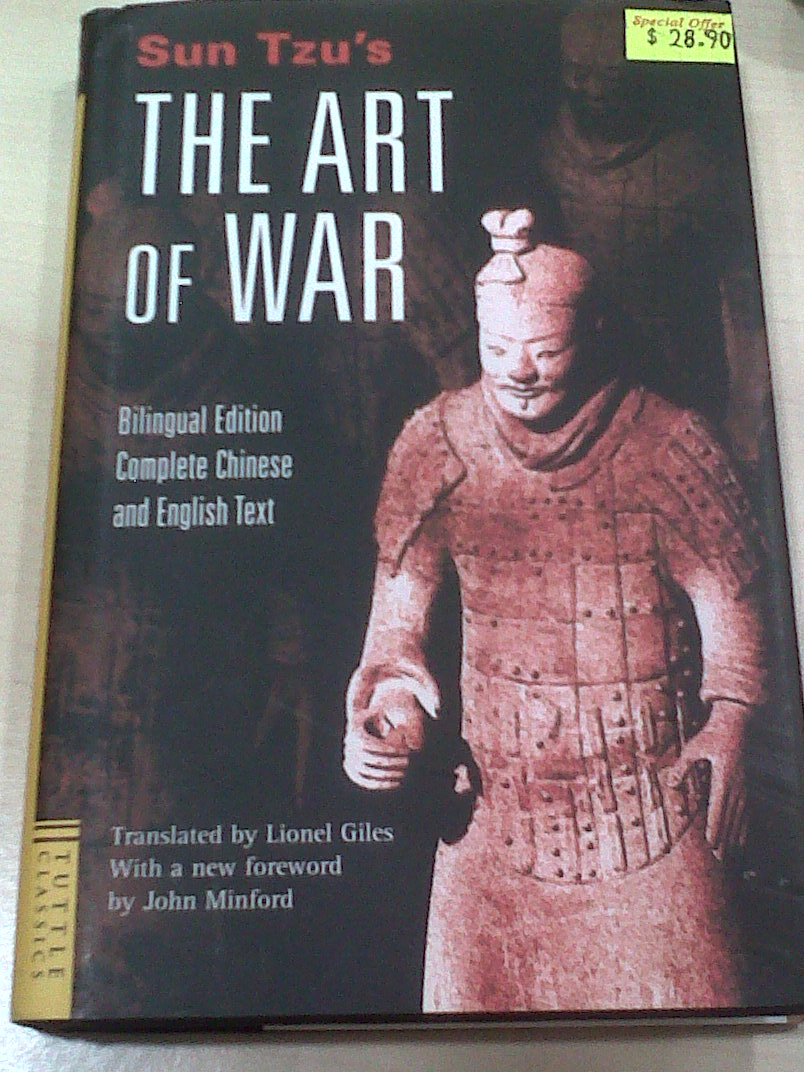
Sun Tzu's The Art of War Translated by Lionel Giles with a new foreword by John Minford


Author:Sunzi, 6th cent. B.C
Publisher:Tokyo ; Rutland, Vt. : Turtle Pub., 2008.
ISBN:9780804839440 (hbk.)
Format:Book
Physical Description:lxvii, 188 p. ; 20 cm.
Subjects:Military art and science China Early works to 1800


The oldest known military treatise, Sun Tzu's the Art of War is still one of the world's most influential writings on strategic thought. Applicable everywhere from the boardroom to the bedroom, from the playing field to the battlefield, its wisdom has never been more highly regarded or used. Now available in its complete form-including an insightful English translation, the entire Chinese language text, and the original translator's often-omitted extensive use and discussion of Chinese characters-this essential examination of the art of strategic thinking features extensive commentary and an insightful historical introduction. 

From Publishers Weekly

Sun-tzu's The Art of War has led military strategists, economists, politicians and other leaders for more than 2,000 years, and has been translated numerous times. Scholar Minford takes a crack at it here, offering a new translation, introduction and commentary. This fundamental volume could be one of the best in recent years, as it features notes on pronunciation, suggestions for further reading, a chronology of Chinese dynasties and historical events, and more. After these briefings, Minford separates the book in two: first, a straightforward translation of Sun-tzu's book, and second, the translation coupled with commentary. "The Art of War is both inspirational and worrying. It is beautiful and chilling....It lends itself to infinite applications," Minford writes. Indeed, this new translation is accessible to anyone seeking guidance, whether they're learning to drive defensively, ironing out relationship kinks or conducting war.
Copyright 2002 Reed Business Information, Inc.

Product Description

For more than two thousand years, Sun-tzu's The Art of War has provided leaders with essential advice on battlefield tactics, managing troops and terrain, and employing cunning and deception. An elemental part of Chinese culture, it has also become a touchstone for the Western struggle for survival and success, whether in battle, in business or relationships.

Book Info

For more than 2000 years, The Art of War has stood as a cornerstone of Chinese culture-a lucid epigrammatic text that reveals as much about human psychology, politics, and economics as it does about battlefield strategy.

About the Author

Little is known about Sun Tzu (544-496 B.C.) and his life during the Warring States period after the decline of the Zhou dysnasty, but his classic, The Art of War, has been one of the central works of Chinese literature for 2500 years. John Minford (editor/translator) studied Chinese at Oxford and at the Australian National University and has taught in China, Hong Kong, and New Zealand. He edited (with Geremie Barme) Seeds of Fire: Chinese Voices of Conscience and (with Joseph S. M. Lau) Chinese Classical Literature: An Anthology of Translations. He has translated numerous works from the Chinese, including the last two volumes of the Penguin Classics edition of Cao Xueqin's eighteenth-century novel The Story of the Stone and the martial-arts fiction of the contemporary Hong Kong novelist Louis Cha.


Thursday, July 1, 2010

The Rules of Life by Richard Templar

The Rules of Life by Richard Templar


Firnando Chau Review


Table of Contents:-
Introduction
Rules for You
1     Keep it under your hat
2     You’ll get older but not necessarily wiser
3     Accept what is done is done
4     Accept yourself
5     Know what counts and what doesn’t
6     Dedicate your life to something
7     Be flexible in your thinking
8     Take an interest in the outside world
9     Be on the side of the angels, not the beasts
10   Only dead fish swim with the stream
11   Be the last to raise your voice
12   Be your own adviser
13   No fear, no surprise, no hesitation, no doubt
14   I wish I’d done that – and I will
15   Count to ten – or recite ‘Baa baa black sheep’
16   Change what you can change, let go of the rest
17   Aim to be the very best at everything you do – not second best
18   Don’t be afraid to dream
19   Don’t dwell on the past
20   Don’t live in the future
21   Get on with life – it’s whooshing past
22   Dress like today is important
23   Have a belief system
24   Have a little space for yourself each day
25   Have a plan
26   Have a sense of humour
27   Choose how you make your bed
28   Life can be a bit like advertising
29   Get used to stepping outside your comfort zone
30   Learn to ask questions
31   Have dignity
32   It’s OK to feel big emotions
33   Keep the faith
34   You’ll never understand everything
35   Know where true happiness comes from
36   Know when to let go – when to walk away
37   Look after yourself
38   Maintain good manners in all things
39   Prune your stuff frequently
40   Remember to touch base
41   Draw the lines around yourself
42   Shop for quality, not price
43   It’s OK to worry, or to know how not to
44   Stay young
45   Throwing money at a problem doesn’t always work
46   Think for yourself
47   You are not  in charge
48   Have something in your life that takes you out of yourself
49   Only the good feel guilty
50   If you can’t say anything nice, don’t say anything at all
Partnership Rules
51    Accept the differences, embrace what you have in common
52   Allow your partner the space to be themselves
53   Be nice
54   You want to do what?
55   Be the first to say sorry
56   Go that extra step in trying to please them
57  Always have someone – or something – that is pleased to see you
58   Know when to listen and when to act
59   Have a passion for your life together
60   Make sure your love making is making love
61   Keep talking
62   Respect privacy
63   Check you both have the same shared goals
64   Treat your partner better than your best friend
65   Contentment is a high aim
66   You don’t both have to have the same rules
Family and Friends Rules
67   If you are going to be a friend, be a good friend
68   Never be too busy for loved ones
69   Let your kids mess up for themselves – they don’t need any help from you
70   Have a little respect and forgiveness for your parents
71   Give your kids a break
72   Never lend money unless you are prepared to write it off
73   There are no bad children
74   Be up around people you love
75   Give your kids responsibilities
76   Your children need to fall out with you to leave home
77   Your kid will have friends you don’t like
78   Your role as a child
79   Your role as a parent
Social Rules
80   We’re all closer than you think
81   It doesn’t hurt to forgive
82   It doesn’t hurt to be helpful
83   Take pride in what we do collectively
84   What’s in it for them?
85   Hang out with positive people
86   Be generous with your time and information
87   Get involved
88   Keep the moral high ground
89   Have a plan for your career
90   Learn to see your community as part of a bigger picture
91   Look at the long-term ramifications of what you do for a living
92   Be good at your job
World Rules
93   Be aware of the damage you are doing
94   Be for the glory, not the degradation
95   Be part of the solution, not the problem
96   Check what history would say about you
97   Keep your eyes open at all times
98   Not everything can be green
99   Put something back
100 Find a new Rule every day – or occasionally at least


Product Description

Some people seem naturally good at it. Life that is. They seem to sail through, being successful and happy and everything always seems to fall into place.

We all know a few of them - those rare people who are happy and positive and make things happen; they have a loving family, great relationships, a supportive network and work they enjoy; they generate goodwill wherever they go and always seem to know the right thing to do – and then do it. They balance their lives without us ever seeing them frantically juggling, much less let it all drop in a mess on the floor. They are happy and successful, with diverse interests and a zest for life. 

How on earth do they do it?

For most of us, some of the time life can be a bit of a struggle. People are difficult, things don’t go our way, there’s too much to deal with and we don’t know how to make it all alright again. 

What is it that they know, that we don’t? 

They know the Rules of Life.

A simple set of principles that if followed, will hugely increase your chances of more things going your way, and that will guide you smoothly out of the tricky times when they happen. Rules of Work worked. Live the Rules of Life.


About the Author


Richard Templar is author of three Prentice Hall international best-sellers: The Rules of Work: A Definitive Guide to Personal Success; The Rules of Management: The Definitive Guide to Managerial Success; and I Don't Want Any More Cheese: I Just Want Out of the Trap. 

Saturday, September 12, 2009

Only the Paranoid Survive: How to Exploit the Crisis Points that Challenge Every Company by Andrew S Grove

Only the Paranoid Survive: How to Exploit the Crisis Points that Challenge Every Company by Andrew S Grove


Firnando Chau Review


Table of Contents
Preface
Chapter 1: Something Changed
Chapter 2: A "10x" Change
Chapter 3: The Morphing Computer Industry
Chapter 4: They're Everywhere
Chapter 5: Why Not Do It Ourselves?
Chapter 6: "Signal?" or "Noise?"
Chapter 7: Let Chaos Reign
Chapter 8: Reign In Chaos
Chapter 9: The Internet: Signal or Noise?, Threat or Promise?
Chapter 10: Career Inflection Points
Index


Synopsis


Under Andy Grove's leadership, Intel has become the world's largest chip maker and one of the most admired companies in the world. In Only the Paranoid Survive, Grove reveals his strategy of focusing on a new way of measuring the nightmare moment every leader dreads—when massive change occurs and a company must, virtually overnight, adapt or fall by the wayside.
Grove calls such a moment a Strategic Inflection Point, which can be set off by almost anything: mega-competition, a change in regulations, or a seemingly modest change in technology. When a Strategic Inflection Point hits, the ordinary rules of business go out the window. Yet, managed right, a Strategic Inflection Point can be an opportunity to win in the marketplace and emerge stronger than ever.


Grove underscores his message by examining his own record of success and failure, including how he navigated the events of the Pentium flaw, which threatened Intel's reputation in 1994, and how he has dealt with the explosions in growth of the Internet. The work of a lifetime, Only the Paranoid Survive is a classic of managerial and leadership skills.

The Currency Paperback edition of Only the Paranoid Survive includes a new chapter about the impact of strategic inflection points on individual careers—how to predict them and how to benefit from them.

About the Author

Andrew S. Grove emigrated to the United States from Hungary in 1956. He participated in the founding of Intel, and became its president in 1979 and chief executive officer in 1987. He was chosen as Time magazine's Man of the Year in 1997. In 1998, he stepped down as CEO of Intel, but continues as chairman of the board. Grove also teaches at the Stanford University Graduate School of Business. He lives in the San Francisco Bay Area.

Friday, August 7, 2009

Blue Ocean Strategy: How to Create Uncontested Market Space and Make Competition Irrelevant by W. Chan Kim and Renée Mauborgne

  • Hardcover: 256 pages
  • Publisher: Harvard Business Press; 1 edition (February 3, 2005)
  • Language: English
  • ISBN-10: 1591396190
  • ISBN-13: 978-1591396192


Blue Ocean Strategy: How to Create Uncontested Market Space and Make Competition Irrelevant by W. Chan Kim and Renée Mauborgne (Hardcover - Feb 3, 2005)

  • Key Points

  • Moving into untapped or uncontested markets (blue oceans) is a preferable strategy to fighting it out in saturated markets (red oceans).
  • Innovation is the key to creating blue oceans. Create something that is new, and you will reap the rewards.

Summary

The authors introduce a “Four Actions Framework” to systematically create blue oceans: Analyzing a business that is competing in a red ocean: 1) Eliminate a part of the offering that is expected 2) Introduce a new offering that is unexpected 3) Reduce an offering 4) Augment an offering
This creates a new offering that is uncontested - at least until it is imitated, which may create a need to apply the same discipline again.

Links

From Publishers Weekly

Kim and Mauborgne's blue ocean metaphor elegantly summarizes their vision of the kind of expanding, competitor-free markets that innovative companies can navigate. Unlike "red oceans," which are well explored and crowded with competitors, "blue oceans" represent "untapped market space" and the "opportunity for highly profitable growth." The only reason more big companies don't set sail for them, they suggest, is that "the dominant focus of strategy work over the past twenty-five years has been on competition-based red ocean strategies"-i.e., finding new ways to cut costs and grow revenue by taking away market share from the competition. With this groundbreaking book, Kim and Mauborgne-both professors at France's INSEAD, the second largest business school in the world-aim to repair that bias. Using dozens of examples-from Southwest Airlines and the Cirque du Soleil to Curves and Starbucks-they present the tools and frameworks they've developed specifically for the task of analyzing blue oceans. They urge companies to "value innovation" that focuses on "utility, price, and cost positions," to "create and capture new demand" and to "focus on the big picture, not the numbers." And while their heavyweight analytical tools may be of real use only to serious strategy planners, their overall vision will inspire entrepreneurs of all stripes, and most of their ideas are presented in a direct, jargon-free manner. Theirs is not the typical business management book's vague call to action; it is a precise, actionable plan for changing the way companies do business with one resounding piece of advice: swim for open waters.
Copyright © Reed Business Information, a division of Reed Elsevier Inc. All rights reserved.

Review

"Blue Ocean Strategy will have you wondering why companies need so much persuasion to stay out of shark-infested waters." -- BusinessWeek, April 4th 2005

"Blue Ocean raises pertinent questions… and delivers valuable answers." -- American Way, March 2005

"Companies struggling to stay afloat in the market's...red oceans would do well to look into Blue Ocean Strategy." -- Fort Worth Star Telegram, 14 February 2005

"The book is clearly written, offering many examples of blue-ocean strategies and the techniques to develop such a scheme." -- Globe and Mail, June 8, 2005

Product Description

Winning by Not Competing: A Fresh Approach to Strategy


Since the dawn of the industrial age, companies have engaged in head-to-head competition in search of sustained, profitable growth. They have fought for competitive advantage, battled over market share, and struggled for differentiation. Yet these hallmarks of competitive strategy are not the way to create profitable growth in the future.


In a book that challenges everything you thought you knew about the requirements for strategic success, W. Chan Kim and Renée Mauborgne argue that cutthroat competition results in nothing but a bloody red ocean of rivals fighting over a shrinking profit pool. Based on a study of 150 strategic moves spanning more than a hundred years and thirty industries, the authors argue that lasting success comes not from battling competitors, but from creating "blue oceans": untapped new market spaces ripe for growth. Such strategic moves-which the authors call "value innovation"- create powerful leaps in value that often render rivals obsolete for more than a decade.


Blue Ocean Strategy presents a systematic approach to making the competition irrelevant and outlines principles and tools any company can use to create and capture blue oceans. A landmark work that upends traditional thinking about strategy, this book charts a bold new path to winning the future.


W. Chan Kim is the Boston Consulting Group Bruce D. Henderson Chair Professor of Strategy and International Management at INSEAD. Renée Mauborgne is the INSEAD Distinguished Fellow and Professor of Strategy and Management.

From the Inside Flap

"After reading Blue Ocean Strategy, you will never again see your competition in quite the same light. Kim and Mauborgne present a compelling case for pursuing strategy with a creative, not combative, approach. Their emphases on value innovation and stakeholder engagement alone make this book a must-read for both executives and students of business."-Carlos Ghosn, President and CEO, Nissan Motor Co., Ltd.
"This is an extremely valuable book to read. It examines the experience of companies in areas as diverse as watches, wine, cement, computers, automobiles, and even the circus to shed new light on the development of future strategies."
-Nicolas G. Hayek, Cofounder and Chairman of the Board, Swatch Group
"I recommend Blue Ocean Strategy to any executive in the private or public sector. It shows how to break from the status quo, create a winning future strategy, and execute this fast at low cost. As much a practical guide as an eye-opener."
-William J. Bratton, Chief of the Los Angeles Police Department, former Police Commissioner of the City of New York
"Kim and Mauborgne's strategies are not only original but practical. Our company has used them and obtained powerful results. The authors chart a bold new path to winning the future."
-Patrick Snowball, Chief Executive, Norwich Union Insurance

From the Back Cover

Companies have long engaged in head-to-head competition in search of sustained, profitable growth. They have fought for competitive advantage, battled over market share, and struggled for differentiation. 
Yet in today’s overcrowded industries, competing head-on results in nothing but a bloody “red ocean” of rivals fighting over a shrinking profit pool. In a book that challenges everything you thought you knew about the requirements fro strategic success, W. Chan Kim and Renee Mauborgne contend that while most companies compete within such red oceans, this strategy is increasingly unlikely to create profitable growth in the future. 
Based on a study of 150 strategic moves spanning more then a hundred years and thirty industries, Kim and Mauborgne argue that tomorrow’s leading companies will succeed not by battling competitors, but by creating “blue ocean” of uncontested market space ripe for growth. Such strategies moves—termed “value innovation”-create powerful leaps in value for both the firm and its buyers, rendering rivals obsolete and unleashing new demand. 
Blue Ocean Strategyprovides a systematic approach to making the competition irrelevant. In this frame-changing book, Kim and Mauborgne present a proven analytical framework and the tools for successfully creating and capturing blue oceans. Examining a wide range of strategic moves across a host of industries, Blue Ocean Strategy highlights the six principles that every company can use to successfully formulate and execute blue ocean strategies. The six principles show how to reconstruct market boundaries, focus on the big picture, reach beyond existing demand, get the strategic sequence right, overcome organizational hurdles, and build execution into strategy. 
Upending traditional thinking about strategy, this landmark book charts “a bold new path to winning the future”.

About the Author

W. Chan Kim is the Boston Consulting Group Bruce D. Henderson Chair Professor of Strategy and International Management at INSEAD. RenĂ©e Mauborgne is the INSEAD Distinguished Fellow and Professor of Strategy and Management.

Wednesday, June 10, 2009

Let's Go into Business Together: 8 Secrets to Successful Business Partnering by Azriela Jaffe

Let's Go into Business Together: 8 Secrets to Successful Business Partnering by Azriela Jaffe (Paperback - Jan 2001)

Monday, April 14, 2008

Who Says Elephants Can't Dance? by Louis V. Gerstner, Jr.

Who Says Elephants Can't Dance?: Inside IBM's Historic Turnaround by Louis V. Gerstner, Jr.


About the Book:-
Format: Paperback, 304pp
Publisher: HarperCollins Publishers, Dec 2003
ISBN-13: 9780060523800
ISBN: 0060523808

Firnando Chau Review

Table of Contents:-
Foreword           
Introduction      
Pt. I        Grabbing Hold  
1              The Courtship   
2              The Announcement
3              Drinking from a Fire Hose            
4              Out to the Field               
5              Operation Bear Hug       
6              Stop the Bleeding (and Hold the Vision)               
7              Creating the Leadership Team  
8              Creating a Global Enterprise       
9              Reviving the Brand         
10           Resetting the Corporate Compensation Philosophy        
11           Back on the Beach          
Pt. II       Strategy              
12           A Brief History of IBM   
13           Making the Big Bets       
14           Services - the Key to Integration              
15           Building the World's Already Biggest Software Business
16           Opening the Company Store     
17           Unstacking the Stack and Focusing the Portfolio               
18           The Emergence of e-business   
19           Reflections on Strategy
Pt. III     Culture
20           On Corporate Culture   
21           An Inside-Out World     
22           Leading by Principles     
Pt. IV     Lessons Learned             
23           Focus - You Have to Know (and Love) Your Business
24           Execution - Strategy Goes Only So Far   
25           Leadership Is Personal  
26           Elephants Can Dance
Pt. V      Observations    
27           The Industry     
28           The System       
29           The Watchers   
30           Corporations and the Community           
31           IBM - a Farewell              
App. A: Employee Communications        
App. B   The Future of e-business
App. C: Financial Overview         
Index

Synopsis (2003)

In 1990, IBM had its most profitable year ever. By 1993, the computer industry had changed so rapidly the company was on its way to losing $16 billion and IBM was on a watch list for extinction -- victimized by its own lumbering size, an insular corporate culture, and the PC era IBM had itself helped invent.

Then Lou Gerstner was brought in to run IBM. Almost everyone watching the rapid demise of this American icon presumed Gerstner had joined IBM to preside over its continued dissolution into a confederation of autonomous business units. This strategy, well underway when he arrived, would have effectively eliminated the corporation that had invented many of the industry's most important technologies.
Instead, Gerstner took hold of the company and demanded the managers work together to re-establish IBM's mission as a customer-focused provider of computing solutions. Moving ahead of his critics, Gerstner made the hold decision to keep the company together, slash prices on his core product to keep the company competitive, and almost defiantly announced, "The last thing IBM needs right now is a vision."
Who Says Elephants Can't Dance? tells the story of IBM's competitive and cultural transformation. In his own words, Gerstner offers a blow-by-blow account of his arrival at the company and his campaign to rebuild the leadership team and give the workforce a renewed sense of purpose. In the process, Gerstner defined a strategy for the computing giant and remade the ossified culture bred by the company's own success.
The first-hand story of an extraordinary turnaround, a unique case study in managing a crisis, and a thoughtful reflection on the computer industry and the principles of leadership, Who Says Elephants Can't Dance? sums up Lou Gerstner's historic business achievement. Taking readers deep into the world of IBM's CEO, Gerstner recounts the high-level meetings and explains the pressure-filled, no-turning-back decisions that had to be made. He also offers his hard-won conclusions about the essence of what makes a great company run.
In the history of modern business, many companies have gone from being industry leaders to the verge of extinction. Through the heroic efforts of a new management team, some of those companies have even succeeded in resuscitating themselves and living on in the shadow of their former stature. But only one company has been at the pinnacle of an industry, fallen to near collapse, and then, beyond anyone's expectations, returned to set the agenda. That company is IBM.
Lou Gerstener, Jr., served as chairman and chief executive officer of IBM from April 1993 to March 2002, when he retired as CEO. He remained chairman of the board through the end of 2002. Before joining IBM, Mr. Gerstner served for four years as chairman and CEO of RJR Nabisco, Inc. This was preceded by an eleven-year career at the American Express Company, where he was president of the parent company and chairman and CEO of its largest subsidiary. Prior to that, Mr. Gerstner was a director of the management consulting firm of McKinsey & Co., Inc. He received a bachelor's degree in engineering from Dartmouth College and an MBA from Harvard Business School.
The New York Times Book Review
The book leaves the reader thinking that a few more Gerstners around in the '90s might have prevented the bubble from swelling so large -- and popping with such a bang.

About the Author (2003)

Lou Gerstner, Jr., served as chairman and chief executive officer of IBM from April 1993 until March 2002, when he retired as CEO. He remained chairman of the board through the end of 2002. Before joining IBM, Mr. Gerstner served for four years as chairman and CEO of RJR Nabisco, Inc. This was preceded by an eleven-year career at the American Express Company, where he was president of the parent company and chairman and CEO of its largest subsidiary. Prior to that, Mr. Gerstner was a director of the management consulting firm of McKinsey & Co., Inc. He received a bachelor's degree in engineering from Dartmouth College and an MBA from Harvard Business School.

Monday, March 31, 2008

In Search of Excellence: Lessons From America's Best-Run Companies by Thomas J. Peters & Robert H. Waterman, Jr.

In Search of Excellence: Lessons From America's Best-Run Companies by Thomas J. Peters & Robert H. Waterman, Jr.

My version is a 1982 Paperback, Warner Books, ISBN 978-0446382823


Firnando Chau Review

The contents of this book are:-
Acknowledgments
Special Acknowlegment: David G. Anderson
Preface
Introduction
Part I: The Saving Remnant
Chapter 1 Successful Ameircan Companies
Part II: Toward New Theory
Chapter 2 The Rational Model
Chapter 3 Man Waiting for Motivation
Part III: Back to Basics
Chapter 4 Managing Ambiguity and Paradox
Chapter 5 A Bias for Action
Chapter 6 Close to the Customer
Chapter 7 Autonomy and Entrepreneurship
Chapter 8 Productivity Through People
Chapter 9 Hands-On, Value Driven
Chapter 10 Stick to the Knitting
Chapter 11 Simple Form, Lean Staff 
Chapter 12 Simultaneous Loose-Tight Properties
Notes
Index

Sunday, October 7, 2007

Leadership Secrets of Attila the Hun


  • Paperback: 110 pages
  • Publisher: Business Plus (February 1, 1990)
  • Language: English
  • ISBN-10: 0446391069
  • ISBN-13: 978-0446391061

  • Review

    H. Ross Perot ...The principles are timeless. -- Review --This text refers to an out of print or unavailable edition of this title.

    Product Description

    Roberts's sensational New York Times bestseller shows how the legendary military commander's principles of leadership can be applied to contemporary business situations.

    About the Author

    Wess Roberts, Ph.D. is the international best-selling author of Leadership Secrets of Attila the Hun, Straight A's Never Made Anybody Rich, and Victory Secrets of Attila the Hun. 


    Dr. Roberts has held senior management positions at major insurance and financial service companies on the West Coast. He served as a major in the U.S. Army where he was assigned for three years to the U.S. Army Combat Arms Training Board. As an adjunct professor at Southern Utah University, Utah State University, and Nova University, Dr. Roberts has taught undergraduate and graduate courses in business, education and psychology. He currently makes his home in Utah, where he writes and lectures on a variety of business and leadership topics.

Sunday, June 17, 2007

How to Be the Person Successful Companies Fight to Keep by Connie Podesta & Jean Gatz

How to Be the Person Successful Companies Fight to Keep: The Insider's Guide to Being Number One in the Workplace by Connie Podesta & Jean Gatz


Firnando Chau Review

Tuesday, April 24, 2007

Got What It Takes?: Successful People Reveal How They Made It to the Top by Bill Boggs

Got What It Takes?: Successful People Reveal How They Made It to the Top by Bill Boggs


My version is a 2007, Hardcover, Collins Living, ISBN 978-0-6-1112292-7

About the Book:-

* Hardcover: 336 pages
* Publisher: Collins Living (April 10, 2007)
* ISBN-10: 0061122920
* ASIN: B0023RT0YU


Firnando Chau Review

The contents of the book are as follow:-
Preface
Biographies in Brief
Introduction: The Reasons for Success
Part One: The Path to Success
Chapter 1 Find Your Path
Chapter 2 Get Hired
Chapter 3 Capitalize on Luck and Timing
Chapter 4 Make Good Decisions
Part Two: The Mind-sets of Success
Chapter 5 Seize Opportunity
Chapter 6 Identify Your Drive, Mission, and Purpose
Chapter 7 Cultivate Self-Confidence
Chapter 8 Strengthen Your Will to Prevail
Chapter 9 Defy Category
Part Three: The Practices of Success
Chapter 10 Work Hard
Chapter 11 Collect Wisdom
Chapter 12 Don't Take Anything for Granted
Chapter 13 Take the Risk
Chapter 14 Develop Excellent Everyday Practices
Part Four: The Challenges of Success
Chapter 15 Confront Fears, Insecurity and Other Inner Demons
Chapter 16 Learn to Cope with Stress
Chapter 17 Allow for Regrets, Failures, and Mistakes
Chapter 18 Overcome Adversity
Chapter 19 Resist Ruinous Temptations
Chapter 20 Keep Your Life in Balance
Part Five: Advice for Success
Chapter 21 Know When to Reassess
Chapter 22 Use What You've Got
Chapter 23 Industry Advice from the Pros
Acknowledgments

--

Amazon.com Review

About the Book

Beyond talent, what factors have determined and defined the careers of well-known individuals? In this book, successful people of our day reveal what it took for them to be successful. Emmy winning interviewer Bill Boggs shares success secrets from leaders in their fields, ranging from major names in entertainment and the arts to sports, fashion, and the business world. They speak frankly about their career paths, crucial influences, how they dealt with adversity, bad luck, bad press, and back-stabbing and the choices they made that helped them to prevail in their careers and in life. Interviewees include Renee Zellweger, Daniel Boulud, Sir Richard Branson, Clive Davis, Bobby Flay, Jim Cramer, Preston Bailey, Brooke Shields, Peter Cincotti, Bobbi Brown, Joseph Abboud, Bob Pittman, Bill Bratton, Mark Burnett, Bill O'Reilly, Mario Cuomo, Frederic Fekkai, Joy Behar, Philadelphia Eagles owner Jeffrey Lurie, Diane Von Furstenberg, Frank Rich, David Rockwell, Jeff Zucker, Anna Quindlen, Norman Lear, Craig Newmark, Tom Perkins, Joe Torre, among others.


From Booklist Review


Four-time Emmy winner Boggs hosts the New York talk show Midday Live with Bill Boggs for Metromedia and FOX, created and hosts Bill Boggs' Corner Table on the Food Network, and has been a game-show host, news anchor, and featured columnist for The Good Life magazine, the New York Times, and other publications. He has interviewed an impressive list of notable personalities during his 25-year career, including presidents, international leaders, athletes, writers, and movie stars. Setting out to define the factors that determine success in high-profile fields, he spoke to 44 individuals and got 44 versions of "what it takes" to reach the top. Interviewees such as Mario Cuomo, Diane Von Furstenberg, Renee Zellweger, Sir Richard Branson, Clive David, Jeff Zucker, Joe Torre, and others reveal sides of their personalities that are often unexpectedly different than their public facades. Includes numerous quotes and reflections on self-doubt, motivation, risk taking, and everyday practices. David Siegfried
Copyright © American Library Association. All rights reserved
 

Review
 
"Interviewees. . .reveal sides of their personalities that are often unexpectedly different than their public facades." -- Booklist

"Wherever you are careerwise–from your first day of work to your last–this easy read of a pep talk speaks volumes." -- Christian Science Monitor


About the Author

Bill Boggs, four-time Emmy Award-winning talk show host and entertainment industry insider, has been a major figure in television for more than 25 years. As host of the New York-based Midday Live with Bill Boggs, NBC's Weekend Today in New York, and the long-running Food Network hit Bill Boggs Corner Table, as well as shows on comedy, history, sports, music, and other topics, he has interviewed many of the most notable personalities of our time. Bill is a graduate of the University of Pennsylvania and holds a Master's degree from Penn's Annenberg School. He and his wife live in New York City. 

Monday, February 12, 2007

Thinking Strategically: The Competitive Edge in Business, Politics, and Everyday Life - Paperback (Apr. 17, 1993) by Avinash K. Dixit and Barry J. Nalebuff

  • Paperback: 416 pages
  • Publisher: W. W. Norton & Company (April 17, 1993)
  • Language: English
  • ISBN-10: 0393310353
  • ISBN-13: 978-0393310351


From Publishers Weekly

Most books on game theory either focus on specialized applications (cardplaying, business, nuclear war) or bore with mathematics and jargon. Free of formulas and argot, this refreshing exception distills the principles, concepts, tools and techniques--brinkmanship, bargaining, unconditional moves, vicious circles, etc.--with an astonishing diversity of illustrative examples drawn from political campaigns, baseball, neighborhood dynamics of segregation, the military draft, speed limits, childrearing and so forth. In helping strategists anticipate rivals' responses and win the game, economics professors Dixit and Nalebuff (who teach game theory at Princeton and Yale, respectively) provide managers, negotiators, athletes, parents and other game-players with a formidable weapon. Drawings. BOMC, Fortune Book Club and QPB selections.
Copyright 1990 Reed Business Information, Inc. --This text refers to an out of print or unavailable edition of this title.

Review

A gem of a book. It makes some important insights on the frontiers of economics and game theory easily accessible, tremendously enjoyable, and practically useful. (Buron G. Malkiel, author of A Random Walk Down Wall Street )


Dixit and Nalebuff set out sure-fire rules for thinking about strategy. (David Henderson - Fortune )


A fascinating new book that can be read with real pleasure. . . . The problem is, of course that if Dixit and Nalebuff can improve your strategic IQ, they can improve your competitor's as well—and the Japanese rights were sold months ago. (David Warsh - Washington Post )

Product Description

The international bestseller—don't compete without it! A major bestseller in Japan, Financial Times Top Ten book of the year, Book-of-the-Month Club bestseller, and required reading at the best business schools, Thinking Strategically is a crash course in outmaneauvering any rival. This entertaining guide builds on scores of case studies taken from business, sports, the movies, politics, and gambling. It outlines the basics of good strategy making and then shows how you can apply them in any area of your life.

About the Author

Avinash K. Dixit is John J.F. Sherrerd University Professor of Economics at Princeton University, where he offers his popular freshman course in game theory. He is among the world’s leading economists, having made fundamental contributions in several major fields, including Game Theory. He is world famous. He is the author of many books, including Thinking Strategically (Norton, 1991), Investment Under Uncertainty (Princeton UP, 1994), and The Art of Strategy (Norton, 2009).


Barry J. Nalebuff is the Milton Steinbach Professor at the Yale School of Management. Nalebuff applies game theory to business strategy and is the co-founder of one of America's fastest-growing companies, Honest Tea.

Friday, August 11, 2006

Smart Moves by Sam Deep & Lyle Sussman

Smart Moves: 14 Steps to Keep Any Boss Happy, 8 Ways to Start Meetings on Time and 1600 More Tips to Get the Best from Yourself and the People Around You by Sam Deep & Lyle Sussman


  • Paperback: 264 pages
  • Publisher: Perseus Books; Stated First Printing edition (March 1990)
  • Language: English
  • ISBN-10: 0201518120
  • ISBN-13: 978-0201518122

From Library Journal

Managers seldom are afforded the luxury of pausing to research potential solutions to on-the-job problems. Deep and Sussman combine their experience from both academia and corporate America to create a useful and fast-moving guidebook to such solutions, covering virtually any management situation that might be encountered by today's manager. The book is divided into 14 broad categories of management activity, ranging from communicating successfully to managing your boss. Each category is accompanied by checklists taken from firms such as Humana and General Electric. Serial rights have been sold to Self and Woman magazines. A good purchase for management collections.
- Richard Paustenbaugh, Indiana Univ. Lib., Bloomington
Copyright 1990 Reed Business Information, Inc.

Product Description

An expansion of the successful self-published book The Manager's Book of Lists, Smart Moves offers over two hundred pages of efficient, practical checklists--already used by such firms as Humana and GE--and gives tips for every management task, from writing powerful memos to winning negotiations and resolving conflicts.


Firnando Chau Review